Skip to main menu
April 2025 issue
Advising Investors for 36+ Years
March 31, 2025
Gráfico M2 vs GNP
M2 Versus GNP

Lorem ipsum dolor sit amet, consectetuer adipiscing elit. Phasellus hendrerit. Pellentesque aliquet nibh nec urna. In nisi neque, aliquet vel, dapibus id, mattis vel, nisi. Sed pretium, ligula sollicitudin laoreet viverra, tortor libero sodales leo, eget blandit nunc tortor eu nibh. Nullam mollis. Ut justo. Suspendisse potenti. Lorem ipsum dolor sit amet, consectetuer adipiscing elit. Phasellus hendrerit. Pellentesque aliquet nibh nec urna. In nisi neque, aliquet vel, dapibus id, mattis vel, nisi.

Ut justo. Suspendisse potenti. Lorem ipsum dolor sit amet, consectetuer adipiscing elit. Phasellus hendrerit. Pellentesque aliquet nibh nec urna. In nisi neque, aliquet vel, dapibus id, mattis vel, nisi. Sed pretium, ligula sollicitudin laoreet viverra, tortor libero sodales leo, eget blandit nunc tortor eu nibh. Nullam mollis. Ut justo. Suspendisse potenti. Lorem ipsum dolor sit amet, consectetuer adipiscing elit. Phasellus hendrerit. Pellentesque aliquet nibh nec urna. In nisi neque, aliquet vel, dapibus id, mattis vel, nisi. Sed pretium, ligula sollicitudin laoreet viverra, tortor libero sodales leo, eget blandit nunc tortor eu nibh. Nullam mollis. Ut justo. Suspendisse potenti.

Lorem ipsum dolor sit amet, consectetuer adipiscing elit. Phasellus hendrerit. Pellentesque aliquet nibh nec urna. In nisi neque, aliquet vel, dapibus id, mattis vel, nisi. Sed pretium, ligula sollicitudin laoreet viverra, tortor libero sodales leo, eget blandit nunc tortor eu nibh. Nullam mollis. Ut justo. Suspendisse potenti.

Lorem ipsum dolor sit amet, consectetuer adipiscing elit. Phasellus hendrerit. Pellentesque aliquet nibh nec urna. In nisi neque, aliquet vel, dapibus id, mattis vel, nisi. Sed pretium, ligula sollicitudin laoreet viverra, tortor libero sodales leo, eget blandit nunc tortor eu nibh. Nullam mollis. Ut justo. Suspendisse potenti.

Lorem ipsum dolor sit amet, consectetuer adipiscing elit. Phasellus hendrerit. Pellentesque aliquet nibh nec urna. In nisi neque, aliquet vel, dapibus id, mattis vel, nisi. Sed pretium, ligula sollicitudin laoreet viverra, tortor libero sodales leo, eget blandit nunc tortor eu nibh. Nullam mollis. Ut justo. Suspendisse potenti.

Sound Advice versus the S&P 500 

Investment Performance Comparision

Growth of $100,000 invested in 2000

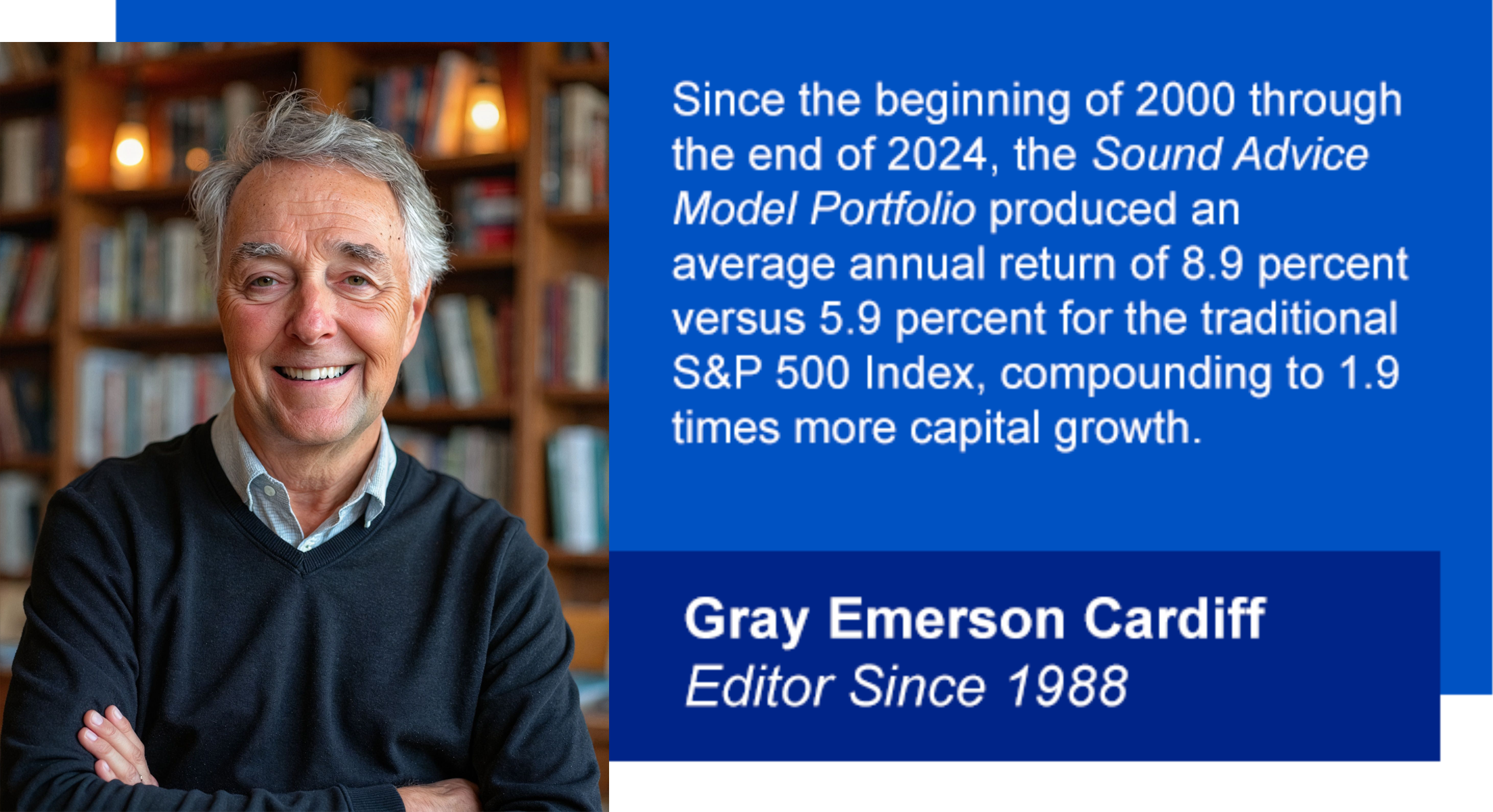
This chart shows the growth Of $100,000 invested In the S&P 500 (In gray) since 2000 would have grown to $400,231, versus $772,409 if it was invested in the Sound Advice recommendations (in blue) for 2.4 times more capital.

Business Cycles and Stocks:
The SoundAdvice Diffusion Indexes
Track record of the
SoundAdvice Diffusion Indexes
Druning the last 49+years, after each “Aggressive” signal, the S&P 500 climbed an average of 31.5 percent. During “Caution” signals, the S&P 500 either crashed, meandered, or climbed, recording an average decrease of 0.6 percent.
Signal Dates (Month-Year)
AggresiveS&P 500CautionS&P 500
Sep-7468.12Apr-76101.9
Jul-76104.20Dec-76104.7
Oct-78100.58Jun-79101.7
Nov-79104.08Oct-83167.7
Aug-84164.48Jun-85188.9
Jul-86240.18Apr-87291.7
Feb-88258.13Jun-88270.7
Mar-89288.00Mar-93449.7
Mar-95493.56Oct-981,141.0
Jun-001,429.40Jan-001,410.0
Jun-03974.50May-051,191.5
Jun-061,276.66Mar-071,386.9
Dec-08 (1)865.58Apr-10 (2)1,197.3
Dec-10 (3)1,232.00Jun-12 (4)1,359.8
Sep-12 (5)1,437.92Mar-14 (5)1,864.9
Mar-152,079.99May-152,111.9
Sep-172,492.84Feb-182,745.7
Mar-20 (7)2,761.98Nov 21 (8)4,667.4
Dec-223,912.38
Ave +/-31.5%-0.6%
Quantitative Easing (QE) Overriding Signals
(1) QE-1 announced 4 months before Aggressive signal
(2) QE-1 terminated into existing Caution signal
(3) QE-2 announced but already in Aggressive mode
(4) QE-2 terminated into existing Caution signal
(5) QE-3 announced, changed to Aggressive mode
(6) QE-3 terminated into existing Caution signal
(7) QE-4 announced, changed to Aggressive mode
(8) QE-4 terminated into existing Caution signal
The Risk Indicator (page 11) reveals long macro cycles. An analogy can be made to the way radio waves work. Long radio waves have frequencies which are assigned to various radio stations, allowing you to distinguish them on your radio. Riding along the path of these long waves are short waves that produce the sound you actually hear on a particular station. These short waves are like the bull and bear markets revealed by the Diffusion Indexes. 
While the path of the long cycles revealed by the Risk Indicator may be in a certain direction, there are bull and bear markets along the way. Of course, these relatively short bull and bear markets are significant during our investing careers. Even during times when the Sound Advice Risk Indicator is above the “low risk” reading, such as it is now, there have been substantial bull markets. We will rely on our Diffusion Indexes to reveal when that will be.
The data we need is contained in the leading and lagging economic indicators. We have hand picked the most sensitive of these economic indicators to produce our “Diffusion Indexes” which function with amazing accuracy as predictors of the birth of cyclical bull and bear markets.
To construct our Sound Advice Diffusion Indexes, we observe changes in each of our selected indicators over a five-month period, and take the percentage of those increasing.
When the Sound Advice Diffusion Index of LEADING Indicators drops to zero, it is time to buy stocks aggressively, regardless of how negative the atmosphere may be. This is not just an empirical coincidence. It is also logical. When all three the leading economic indicators decline compared to five months earlier, it reveals that the soft economy is providing an atmosphere for declining short-term interest rates.This Diffusion Index gave us a zero reading in December 2008, close to the bottom, officially giving us an “Aggressive” signal. That signal came at a time when the Risk Indicator was below 1.0, which revealed that Supercycle 5 came to an end, and that Supercycle 6 was born.
The Sound Advice Diffusion Index of LAGGING Indicators gives “Caution” signals when all three of its individual lagging economic indicators rise above their respective levels of six months earlier, providing a 100 percent reading. This reading reveals that the US economy is strong enough to put upward pressures on interest rates.
A Powerful Overriding Force
Most of the time, the Diffusion Indexes are excellent detectors of the natural business cycle and a path to the science of making money in the stock market. However, the forces of the natural business cycle can be dominated by extraordinary changes in monetary policy during emergency situations.
The COVID-19 pandemic was the most recent example. In mid-March 2020, the Federal Reserve declared the institution of its fourth “Quantitative Easing” (QE) program whereby it dropped the Federal Funds rate to zero and commenced buying massing amounts of US Treasury bonds. With its mighty power, the Fed drove down interest rates and infused massive amounts of liquidity into the US economy. The money supply mushroomed.
At times like this, we need to ignore readings from the Diffusion Indexes. Interest rates are dropping by the Federal Reserve’s mandate, just as if the Diffusion Index of Leading Indicators had plunged to zero. Conversely, whenever the Federal Reserve declares an end to its QE program, we return to our Diffusion Indexes to follow their readings. If the Diffusion Index has moved to a “Caution” signal during the QE program, we should follow that reading. This is the most likely pattern of events because the economy will likely have strengthened in order for the Federal Reserve to end its QE program.
The impact of the Federal Reserve’s four QE programs on existing Diffusion Index signals are noted in the footnotes under the track record table.
Current Status
Our current “Aggressive” mode was established by a zero reading for the Diffusion Index of LEADING Indicators in December 2022 based on the indicators for November 2022. The latest reading is zero percent, revealing once again that the soft economy is providing an atmosphere for declining short-term interest rates.
Our next signal will be a “Caution” signal from a 100 percent reading on the Diffusion Index of LAGGING Indicators which recorded 33 percent based on the latest indicators.
The 2025 Edition: 
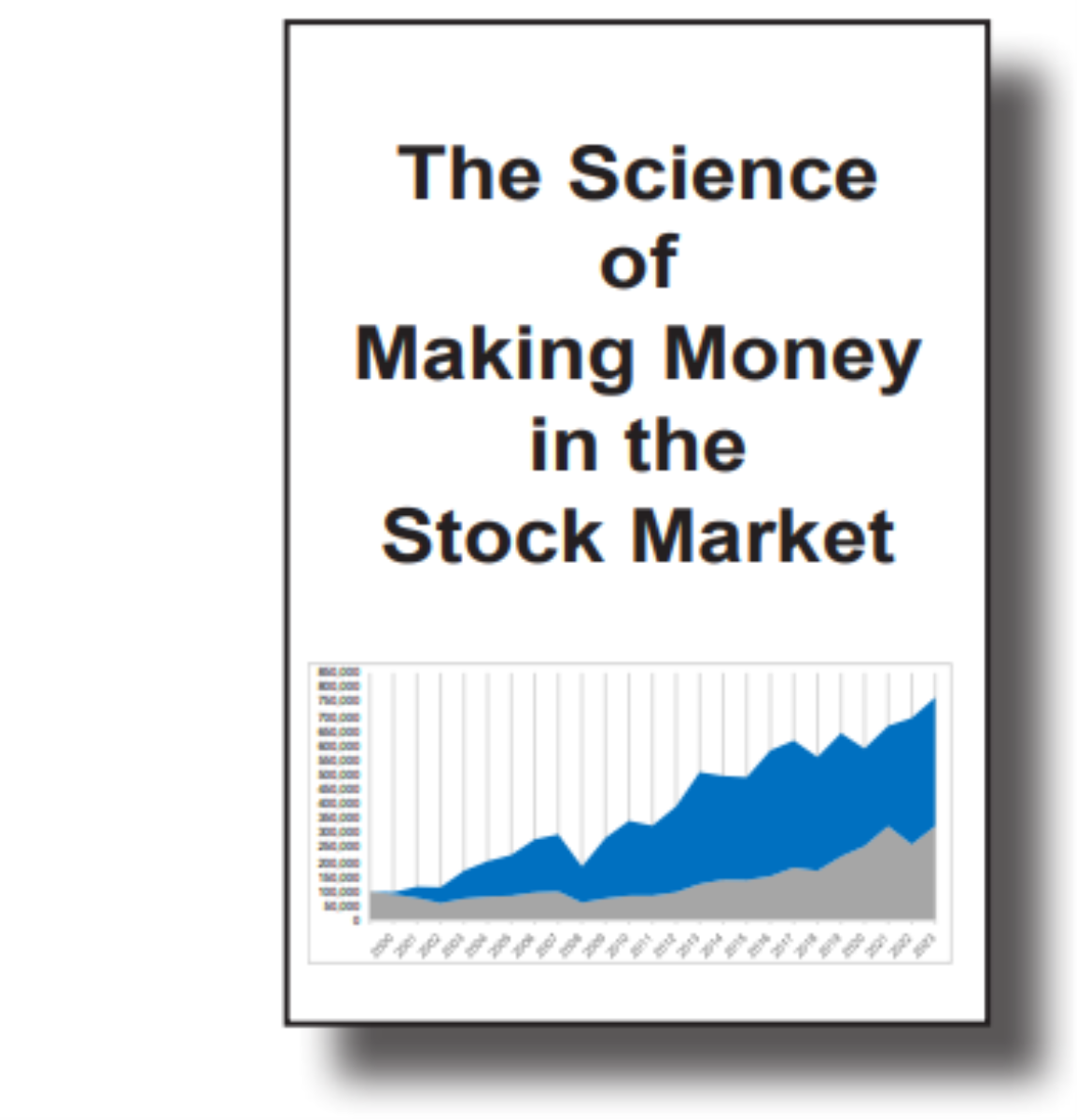
The Science of Making Money in the Stock Market
By Gray Emerson Cardiff
For Kindles, Ipads, and in Paperback
This book that explains all of the SoundAdvice indicators, including the Diffusion Indexes and Risk Indicator, and exactly how they work, along with a detailed history to back up the track records.
Price $7.99 (Free for Kindle Unlimited). Free to share with friends and relatives.
Capital Competition: Real Estate versus Stocks:
The SoundAdvice Risk Indicator
There are few forces that are more important to a market’s destiny than the amount of capital that is available to it. In a normal situation, capital will flow easily between markets as their underlying conditions change. But if a market becomes dangerously superheated, it will absorb a larger proportion of available investment capital than economic conditions and market demand can justify. This change will be reflected not only in the rising market’s prices but also in the prices of competing markets, which will be lower than their underlying fundamentals would indicate they should be. Over the last 120+ years, we can see this titanic struggle between the stock market and its foremost competitor for investment dollars: real estate
To reveal this phenomenon, we have set up an equation based on the ratio of the S&P 500 Stock Index to median price of new houses for each month over the last 100+ years. This equation exhibits an elegant financial minuet as each market has taken turns outperforming the other.
As we look at the historical data, we find that there is a range in which the price disparities are so strong that they are too great to be accounted for by the fundamental economic conditions underlying each market. Every time prices get into these danger zones it has meant that the prices in one market or the other have gone too high, and that they are in imminent danger of falling.
We label this new tool the Sound Advice “Risk Indicator,” since it will allow us to locate the point at which prices are so high when compared to competing markets that they have come loose from their moorings and are on the verge of declining or under performing the other market.
What is too high? When stock prices are very high relative to house prices, the Sound Advice Risk Indicator will rise over the line marked 2.0, revealing a high-risk time for stocks. In contrast, when the indicator drops below the line marked 1.0, it means that it is a very low-risk time to buy stocks. Notice from the chart how the Sound Advice Risk Indicator has oscillated back and forth, revealing the ongoing struggle between stocks and houses for investment capital. We have labeled these long vacillations Supercycles.
Although an investment beginning with $25,000 in1895 could have made money being in either stocks or housing, had an investor followed the signals of the Sound Advice Risk Indicator, he or she would have made $560 million versus $34 million by simply holding stocks through the ups and downs, or 17 times more money.
With the latest median house price at 403,700 in March 2025 (the latest data) and with the S&P 500 averaging 5,811 in May, the Sound Advice Risk Indicator read 3.1.